Neuromarketing is two things
Neuromarketing is actually two categories that share a name. The first is the twenty-year-old EEG-cap vendor market that mostly failed to deliver and is now consolidating. The second is a brand-new infrastructure category built on forward neural encoding models, AI facial coding, and multimodal prediction. The first has earned its skeptics. The second has not yet earned its believers.
You will be confused by every search result you read on neuromarketing unless you hold those two definitions separately. Most articles conflate them, usually by accident.
The first category earned its skeptics. The second has not yet earned its believers. Treat them differently.
A short history
Modern neuromarketing research starts with McClure et al. in Neuron 2004[1]. The study put participants in an fMRI scanner and showed them Coke and Pepsi, with and without brand cues. The medial prefrontal cortex engaged when the brand was visible. Ventromedial prefrontal cortex correlated with blind preference. The finding was real. What happened next was hype.
Martin Lindstrom published Buyology in 2008. It popularized a "buy button in the brain" framing that reviewers in the field quietly criticized for missing controls and making reverse-inference leaps. Roger Dooley[2] and Sentient Decision Science[3] published detailed takedowns. The book sold regardless.
A.K. Pradeep founded NeuroFocus in 2005 and sold it to Nielsen in 2011. Innerscope Research, the MIT Media Lab spinout led by Carl Marci and Brian Levine, was founded in 2006 and acquired by Nielsen in May 2015[4] to form the Consumer Neuroscience unit. For a few years, neuromarketing looked like it had won enterprise validation.
The reverse inference problem
In 2006 Russell Poldrack published a four-page paper in Trends in Cognitive Sciences[5] that should have ended half the neuromarketing industry's sales pitch. The argument is simple. You cannot infer a cognitive process from a regional activation without knowing how specific that region is to that process.
Formally, P(process | activation) depends on the selectivity of the region. The medial prefrontal cortex and the insula activate across hundreds of cognitive tasks. Saying "mPFC lit up, therefore the viewer experienced emotional engagement with the brand" is a Bayesian mistake. Poldrack's 2011 follow-up in Neuron[6] formalized the correction: forward prediction (stimulus to neural response) routes around the problem. Reverse inference (neural response to cognitive state) does not.
We wrote a longer methodology piece on the reverse-inference problem (see the twenty-years-on piece).
What the evidence actually says about legacy neuromarketing
The honest net across the peer-reviewed record is that neural data has incremental predictive validity over self-report, but much weaker than vendor marketing copy implied.
Venkatraman et al. in JMR 2015[7] tested several neural and self-report measures against market-level advertising outcomes across thirty TV ads. Ventral striatum fMRI signal uniquely predicted sales, with incremental R² of roughly 0.10 to 0.14 over traditional measures. That is a real effect and the strongest single piece of evidence for neural data in advertising research.
Varan, Lang, Barwise, Weber, and Bellman in JAR 2015[8] looked at the ARF Neuro 1 and Neuro 2 comparison studies. They found opaque vendor constructs and weak inter-vendor agreement. Different vendors scoring the same ads produced different rank orders. The field had not earned the accuracy claims that populated its sales decks.
Ariely and Berns's 2010 Nature Reviews Neuroscience piece[9] remains the balanced starting point. They named the hope and the hype at the same time, and their critique largely held up.
What consolidation actually looked like
In 2020, Nielsen shut seventeen ex-US Consumer Neuroscience labs and cut roughly eighty percent of that unit's headcount[10]. The unit was absorbed into NielsenIQ without a clean formal shutdown announcement. A.K. Pradeep's trajectory since NeuroFocus has moved through several smaller ventures without returning to scale. The collapse was not abrupt. It was a slow unwind of claims the category had never calibrated in public.
Notable exception: System1 Group in the UK (LSE:SYS1, founded by John Kearon) quietly outperformed the EEG-cap vendors by focusing on emotion and attention with minimal neuro-dressing. The playbook that worked was not the one with the brain imaging. It was the one with rigorous consumer response measurement and transparent methodology. That is a clue about what actually generalizes.
The new thing, which is not the old thing
The second category is an infrastructure category. It is built on forward encoding models. TRIBE v2 from Meta FAIR[11] predicts fMRI BOLD response across roughly seventy thousand cortical voxels from video input, trained on over a thousand hours of fMRI. MindEye and MindEye2[12] decode images from within-subject fMRI. The Huth Lab's semantic maps[13] represent distributed semantic tuning across cortex.
These models make forward-prediction claims, not reverse-inference claims. TRIBE predicts neural response from stimulus. MindEye decodes within trained subjects. Neither says "this region indicates this cognitive state in a typical viewer." That seemingly subtle direction-of-inference flip is the difference between a paradigm that has to answer Poldrack and one that routes around him.
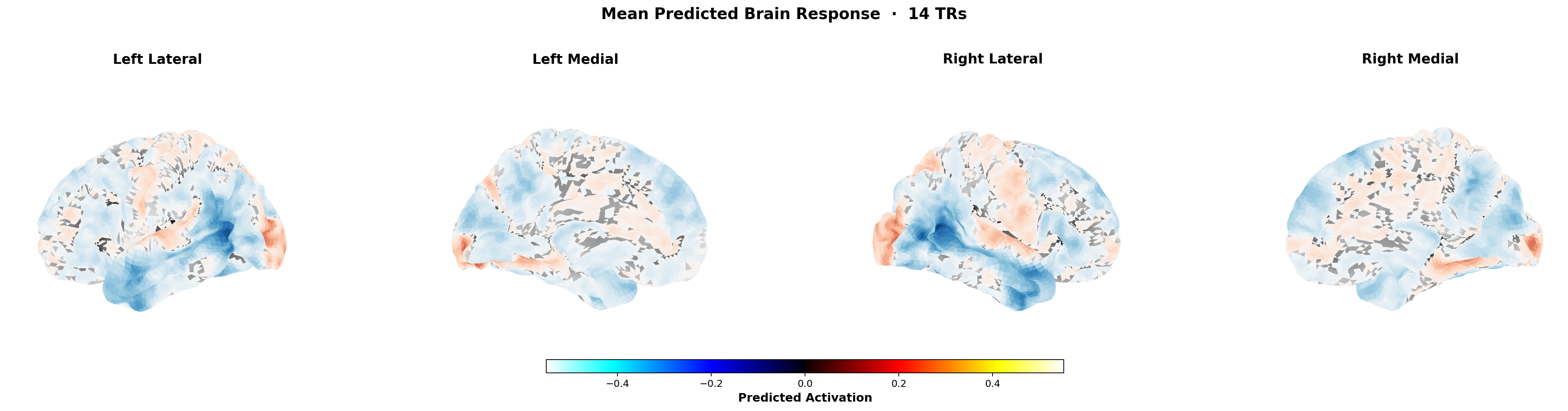
We wrote a separate technical review (see the encoding models review) and a full TRIBE v2 explainer (see TRIBE v2 explained).
What a sophisticated buyer should ask in 2026
Four questions filter the legitimate vendors from the rebranded EEG houses.
- Do you publish calibration studies against field outcomes like sales, CTR, or retention? If not, why not.
- Are your claims forward-prediction or reverse-inference in structure? Can you articulate the difference.
- What happens to your model on out-of-distribution creative? Short-form vertical video. Non-English language. Novel formats.
- Can you show correlation to market outcomes, not just correlation to self-report.
The OpenAffect framing
Neuromarketing in the new category is one signal of four. Neural response alone is not content intelligence. It has to be fused with linguistic, cultural, and historical signals to produce a prediction that holds up on out-of-distribution creative. That is the framework we build on (see the four signals).
Neuromarketing is two categories. Do not confuse them. Do not buy one when you want the other. Do not buy either unless the vendor publishes calibration.
References
- 1McClure, Li, Tomlin, Cypert, Montague, Montague. Neural correlates of behavioral preference for culturally familiar drinks. Neuron 2004.
- 2Dooley. Buyology by Martin Lindstrom. Neuroscience Marketing.
- 3Sentient Decision Science. Buyology review: looking at marketing through the brain.
- 4Nielsen acquires Innerscope. Advertising Age 2015.
- 5Poldrack. Can cognitive processes be inferred from neuroimaging data? Trends in Cognitive Sciences 2006.
- 6Poldrack. Inferring mental states from neuroimaging data: from reverse inference to large-scale decoding. Neuron 2011.
- 7Venkatraman et al. Predicting advertising success beyond traditional measures. JMR 2015.
- 8Varan, Lang, Barwise, Weber, Bellman. How reliable are neuromarketers' measures? JAR 2015.
- 9Ariely and Berns. Neuromarketing: the hope and hype of neuroimaging in business. Nature Reviews Neuroscience 2010.
- 10Marketing Dive. Nielsen cuts neuromarketing research amid pandemic. 2020.
- 11Meta AI. TRIBE v2: A brain predictive foundation model. 2026.
- 12Scotti et al. MindEye2: shared-subject models enable fMRI-to-image with one hour of data. ICML 2024.
- 13Tang, LeBel, Jain, Huth. Semantic reconstruction of continuous language from non-invasive brain recordings. Nature Neuroscience 2023.